Mathasit Addok
Mathasit Addok
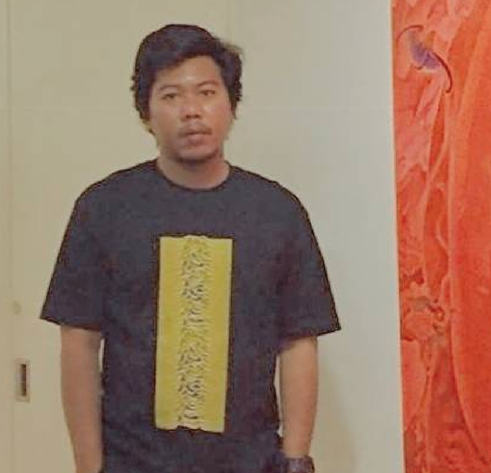
Mathasit Addok (Thailand),originally from Bang Waek, Phasi Charoen District, Bangkok, graduated with second-class honors in the Department of Thai Art, Faculty of Painting, Sculpture and Graphic Arts, Silpakorn University, and a doctorate in Art Management. He is currently the dean and art lecturer at the Faculty of Fine and Applied Arts, Bangkok Thonburi University. His outstanding works in his identity are the expression of traditional Thai paintings that use the patterns of plants and natural forms to express the content of important parts of the life story of the Buddha, using color to determine the content to communicate the principles of the Buddha’s teachings. He works have received awards and recognition from the Bualuang Painting Competition organized by the Bangkok Bank Foundation, such as the painting Enlightenment, which won the Bualuang Gold Medal in the 33rd Traditional Thai Painting Category, the painting Parinirvana, which won the Bualuang Silver Medal in the 34th Traditional Thai Painting Category, and the painting Ratanajongkrom Chedi, which won the Bualuang Silver Medal in the 35th Traditional Thai Painting Category. He also has solo exhibitions in the PARAMI series and group exhibitions in various art galleries. At the national and international level, He has joined the Thai Painters Group and participated in various activities in the Thai Painters Group.
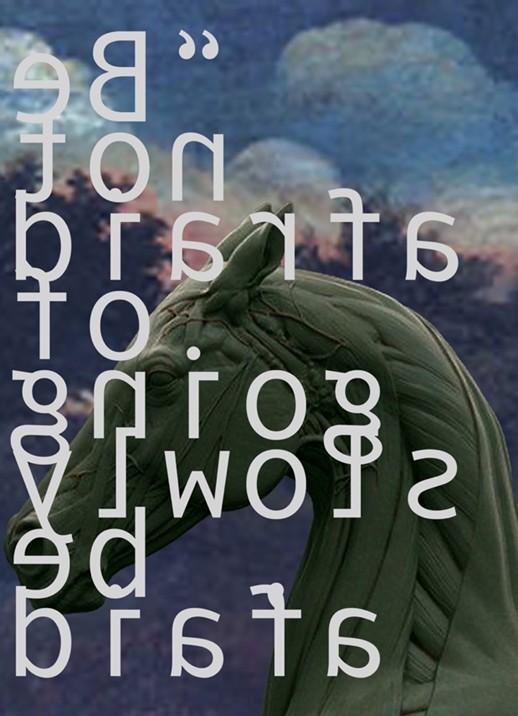
《 Be not afraid of going slowly, be afraid》(No.02)
Print Digital and Gold leaf
60×40 cm.
Concept: The horse is employed as a central symbol through which the work questions the meaning of movement in the modern world. Throughout human history, the horse has represented power, speed, victory, political authority, and territorial expansion. In this work, however, the horse appears in a state of slowness, weight, and stillness, as if released from its historical role as an instrument of warfare or acceleration.
By presenting the horse’s head in a sculptural form, the image transforms the horse into a monument of time rather than a living body in motion. It does not surge forward; instead, it exists in a condition of inner movement, reflecting a shift in symbolism from external power toward internal contemplation within human consciousness.
The overlaid text functions as traces of language, ideology, and social commands historically imposed upon the horse—demands for speed, control, and directed force. The fragmented and obstructed reading disrupts visual fluency, compelling the viewer to slow their perception, mirroring the horse’s restrained and unhurried rhythm.
Within this context, the horse becomes a metaphor for contemporary humanity burdened by the constant expectation to “move forward,” yet increasingly questioning whether progress must always be fast. The work suggests that true courage in the present era is not found in speed, but in the determination to continue moving, slowly yet without standing still.