Heike Willmaser
Heike Willmaser
Heike Willmaser, born on 9 April 1963 in Gera, Thuringia, spent her childhood and youth in an artistic family. Her biography, her training, including periods of study and practice in Munich and Passau, as well as her long-standing presence in the cultural life of Vienna, are already well documented.
“Trees do not grow, they flow upwards like a fresh spring, until they return their water to the forest. Everything that is in the trees is in us.” (Quote by Esus Druid Master)
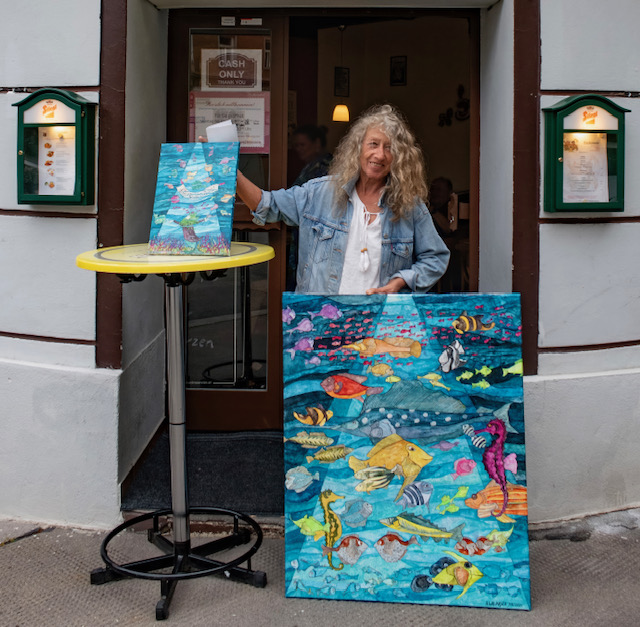
Her art flows cheerfully and positively through a time marked by political crises, Heike Willmaser entices us into a world of harmony, beauty and peace. Her idyllic pictures of trees and sunflowers, of squares and alleys, where cats and birds meet, are far removed from the bad news that surround us every day. The expressive versatility of her works shows a typical, strictly individual handwriting, in which figurative motifs, panoramas and ornamental plant-forms overlap in fantastic pictorial spaces. A structural mixture of cubist-like fragmentations with surreal, partly ironic-naive influences results in a very individual combination that makes her style of painting unforgetable.
Formally, a recurring dialectic can be observed: on the one hand, the carefully constructed geometric structuring of spaces and surfaces, and on the other hand, a sweetly associative sensitivity to color and a narrative figurative repertoire that often drifts in the direction of children’s book illustrations. This tension between order and narrative playfulness is reminiscent of historical lines of modernism – for example, the analytical decomposition of the pictorial space in Picasso, combined with the poetic imagination of Marc Chagall, or the gestural directness that is reflected in Paul Klee’s play with forms. Although inspired by these, Heike Willmaser’s work remains consistently independent.
A special fondness for motifs from Italy and Vienna will be noticeable, recurring places of longing for an artist who grew up in the GDR, whose father was a painter and whose mother was a puppeteer in the marionette theater. The parental home and the omnipresent smell of oil paints awakened the desire to become a painter in her already delicate childhood. Since 1989, Heike Willmaser has been working as a freelance artist, and she came to Vienna to stay – in the city of her dreams, where she likes to live and work.
She has the ability to memorize images, says Heike Willmaser, and inspiration comes to her on the go; she always has her sketchbook and smartphone at hand to capture strong impressions.
Her concentration on the essentials and her artistic exploration of what she has seen begins in the studio. She likes to draw on the inspirations of classical modernism, which she incorporates in a stylish and self-taught manner, as in the parable of the tree that absorbs water from the past to give it back in the present as a refreshing source.
In 2000, Heike Willmaser designed her “Astrology Path,” the third section of the “Walk of Art” (an idea by Friedensreich Hundertwasser), which formed the visual link between the Hundertwasserhaus and the Kunst-Haus in Vienna. She also found another field of activity as an author of children’s books and illustrator of her own fairy tales. In addition, she also worked as a puppeteer and created unusual marionette puppets.
“Every child is an artist. The problem is how to remain an artist as one grows up,” she likes to quote the famous saying of her role model Pablo Picasso. She is not lacking in ideas, as art is known to wash the dust from our souls!
In 1999 Heike Willmaser was accepted into the Art-Forum Graz art association, and in 2005 she became a member of the Austrian-Romanian Cultural Institute. In the same year the Austrian Post honored her work by issuing 3 special stamps featuring selected subjects from her paintings. Since 2009 she has participated in the annual exhibitions at “Kunst zu Recht” curated by the Viennese Central Court.
Heike Willmaser has already presented her work in numerous vernissages, projects and publications, and many exhibition projects in Austria and abroad, as well as film documentaries, have underscored the public presence of her work. The art market has long since registered her oeuvre, which is well documented in auction and catalog records. Heike Willmaser’s art opens up stylistically consistent worlds of images that encourage us to look and to tell stories, while at the same time being technically precise and free in their associations, qualities that have long since been evident in her artistic work.